Showing posts with label Books. Show all posts

Friday, 6 February 2026

Books: shelf life / The artist's studio / Vispo: What Am I?


A photo of part of my studio. I don't have a studio. That's just one of my book shelves. But it is close to where I make art. About four feet away.

Scrolling through Instagram the other day I saw someone's studio. It was extremely tidy. I wondered if a hair on the work surface caused them distress. Their work is also tidy. Very clean. Precise. Measured. So I conclude that the state of an artist's studio may often reflect the nature of their work. Francis Bacon's studio was famously messy. 


Whilst his work couldn't be described as 'messy', I think there are raw, wild, uncontained elements to his paintings which are reflected in the chaos of the studio. Those nightmarish smears...the violent brush strokes. 

Sometimes I wish I had a studio, if only to hold cabinets where my work could be neatly put away. As you know, the kind of work I produce really doesn't demand lots of space. My desk is the crucial item. But even without that, I would only need a space to put the typewriter on or make collages. If I had a studio, would I make larger work? Possibly. But even then, large works can only be shown in galleries and I'm not in love with the idea of gallery shows. I've taken part in a few and was left...underwhelmed. The internet is a better gallery and suits what I do because my work can be scanned and posted.

The other day I decided to type on a page from an old sci-fi magazine. I usually draw on them but have typed before. The art is to make the type a strong element as it battles with the printed word. As usual, I had seen a line which I wanted to be read. The red shape was outlined first, then the mass of type created to fit it. The red ink went on next followed by what's typed onto that. 

What Am I?, RTomens 2026

TTFN

Sunday, 22 June 2025

Vispo print: Shutdown & Cancelled / Mind Games booklet / Book: Least Wanted - A Century of American Mugshots / Vispo: Wrongthink, Understanding A Sentence, Now I'm Just A Number


RTomens, 2025

Some of you will recognise the Faceless Man from the cover of a booklet I made last year called Mind Games. There are still a few copies of the latest print run left if you'd like one. See here. I added 'Cancelled' to his face this week. Just 'cause I felt like it.

Most of the faces featured in Mind Games came from this fantastic book, Least Wanted  - A Century of American Mugshots...


I didn't know it at the time when I got it for a fiver in a charity shop but it's now out of print and pricey online. It's turned out to be one of the most cherished books in my collection, not only because I've used the images but because it's such a brilliant book. The character in the middle row, for instance, is featured in a piece called Wrongthink, which I made on Friday.

RTomens, 2025

Here's another...


RTomens, 2024

The text is by Wittgenstein. The piece is called Understanding A Sentence. Geddit? Of course you do. Here's one more. Title: Now I'm Just A Number.


RTomens, 2024

Be careful out there or you'll end up having your own mugshot...for a mean tweet.

TTFN!

Thursday, 6 February 2025

Book: Tomorrow Inc - S.F. Stories about Big Business (1977) / Tomorrow's World


'We all have basic needs like food, sex, clothing and shelter.  Almost everything else (including the book you are now reading) is wants, often artificially created by the culture in which we live.' - From the introduction to Ballard's The Subliminal Man


True, true - of course I didn't need another book! I bought it anyway, not because it was forced onto me through subliminal advertising but because I was already aware of it and whilst searching the online Oxfam shop's sci-fi section it appeared at an irresistibly reduced price of £6. 

I like the theme and what a great cover (no credit given for the designer). Love that 'futuristic' font too, a variation on the one used by the BBC's Tomorrow's World  (first transmitted on 7 July 1965)


Tomorrow's World looked at developments in science and technology. By the 70s it was attracting 10 million viewers per week, including my family. Science for the masses! You may find it hard to believe but trust me when I tell you that the programme's popularity did not reflect a sudden awakening to the wonders of science on behalf of the proletariat. No. It was essential escapism from the reality of industrial Britain, heavy Industrial Britain, you know, when we still had an industry, we made things, important things like steel...and we dug up tons of coal, which came in handy too...and men were men who did the dirty, dangerous work, not the wimps of today sat tapping keys in offices all day because what Tomorrow's World predicted came true in the form of computers in every home, office and hand!

Yes, real men, 70s men, such as the miners, willing to strike at the drop of a fag butt and stay on strike until they got what they wanted even when it meant the government deciding to ration the use of electricity therefore probably preventing everyone from being able to watch Tomorrow's World. The television broadcasting restrictions were introduced on 17 December 1973, suspended for the Christmas and New Year period, and lifted on 8 February 1974. I remember those candle-lit nights but I can't remember what we did as a family. It must have been hard. I'm guessing playing cards were useful. Board games? Long conversations? Not likely...

'This terminal is linked to a giant brain' says the narrator - ha-ha! I love it - very sci-fi. The warning signs were there. In the next century, giant Silicon Valley 'brains' would be manipulating information, tracking our every move online and censoring material not deemed politically acceptable (laptop? What laptop?). And there's little Nicholas, aged four, an early adopter and innocent forerunner of today's young addicts who, at a slightly later stage, laugh at their parents' attempts to monitor their online activity whilst they peruse porn, follow lifestyle influencers and watch Drill videos under the duvet.


When it comes to book-buying, as helpless consumers we addicts may as well live in an area where giant signs advertising must-have reads loom large over roads and houses (as in Ballard's story). Unlike the fictitious one though, the scenario would have to be a purely personal one. The signs would not say 'BUY NOW NEW CAR NOW' as they do in the story but 'BUY ----- (desired book) NOW BUY NEW ------ NOW'. 

Now we 'drive' along the highways and byways of the internet, the not-so-subliminal signage taking the form of shopping baskets on various sites, filled with thumbnail images of what we want and so, ironically, it isn't size that counts; it doesn't need to be a massive billboard, just a small representation of our desires. No great effort required. No visits to a showroom. Just the click of a mouse! Tomorrow's world today and all the books we desire, instantly! 

Monday, 27 January 2025

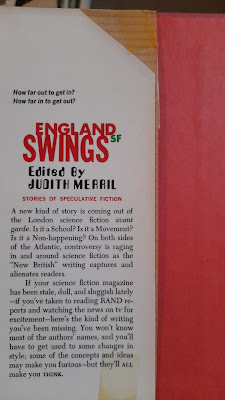
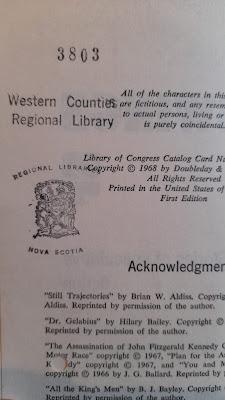
England Swings SF (ed Judith Merrill) - The Nova (Scotia) Science-fiction connection


Nova being the feminine form of novus, meaning "new", it's appropriate that this, my favourite science-fiction anthology, travelled all the way from Nova Scotia to finally come to rest in my London home. It is, after all, very much a New Wave SF collection. The idea of such a 'new' thing (in 1968) even being in Nova Scotia seems incredulous, but then, we can't imagine how far artifacts from Swinging England travelled when they were still fresh. It could, of course, have ended up there at any time since, assuming they have a secondhand section. 

Nova Publications was formed in 1949 in order to keep New Worlds magazine going and so, with Michael Moorcock transforming it into the New Wave SF mag, the nova connection, my book and it's origin in Canada is complete.


Wednesday, 1 May 2024

Books: Aircraft - Le Corbusier / The Unlimited Dream Company - J. G. Ballard / Aircraft coincidences


I can't say for sure that Corbusier started it. Or I could. It would be a more interesting opening sentence: 'Le Corbusier started it!', but you know as well as I do that he couldn't 'start' anything. Hold on...

It could be said that Le Corbusier's book, Aircraft, started something....I suppose. Start again...

It started when I pulled Le Corbusier's Aircraft out from whatever it was wedged between and stuck it on display. What started? You'll see...

I was struck by how beautiful the cover is...how simple, direct, clear, graphically. Anyway, a few days later I'm browsing the basement of a West End bookshop when I come across The Unlimited Dream Company by J. G. Ballard, wondering 'Do I have this? I must have this...perhaps I don't.' I bought it. Luckily, no other edition lurked on the shelves. I couldn't believe it had escaped 'the net'. It had also escaped my memory, which is full of holes, big holes, like the most useless net imaginable.

Turns out it's one of the wildest books Ballard has ever written and yes that includes Crash. When Blake crashes his plane in the Thames at Shepperton it begins a series of fantastical events as Blake, being dead/not dead, discovers he has amazing powers and rampant desires. He transforms the environment completely. I'll say no more for fear of ruining your enjoyment. 


So I went from Aircraft to Blake's aircraft crashing, quite by coincidence. I'm sure Ballard was aware of Le Corbusier's book. Maybe not. 

As I neared the end of Ballard's novel we decided to go for a day out at Shoreham-by-Sea. LJ chose the place. It's an enjoyable little town on a river over which there's a bridge leading to the sea. We walked the other side of the river, heading West, over the road and into the countryside, following the Adur. Guess what was to our left...an airport for light aircraft. We stood and watched a few taking off and landing. I was mesmerised, partly thinking of Ballard's character, Blake, but also by the sight of people brave enough to fly. 

The airport (Brighton City Airport) terminal is a thing of beauty in itself, opened in 1936, a year after Le Corbusier's book was published. From the elegance of Aircraft to the sight of this Art Deco gem seemed like an appropriate way to end the recent flight theme in my life. 


Thursday, 25 January 2024

Book: Reshaping The Invisible (1963) / Collage: Liberation Through Chemicals


Charity shop find yesterday. It was priced at five pounds but some pages are about to fall out so I asked if five pounds was the pages-falling-out price or the we-hadn't-noticed-the-loose-pages price. Deciding it was the latter, he took a quid off. Imagine (can you?) how thrilled I was to open this very plain, anonymous-looking book to find it filled with fantastic full-bleed colour (Agfacolor) images. It was produced to commemorate the 100th anniversary of the pharmaceutical and biotechnology company, Bayer, who, funnily enough, trademarked and marketed Heroin from 1898 to 1910. It's funny because the title of the opening essay is: 'Liberation Through Chemical Research'. I don't think heroin ever liberated anyone.


So I was/am torn (not pun intended since I use scissors mostly but do tear sometimes) between using the pages for collage or keeping them untouched. This afternoon I went the third way by altering scanned images from the book on the computer, plus one from a film annual. Here's the result.

RTomens, 2024

As I was saying to a friend the other day, I prefer paper collage to digital (you noticed?). I like it for the reasons usually stated; the feel, the rawness, the handmade look. Yes, I know software can recreate all those things but I've never felt inclined to learn a program that will do it. Plus, I confess, that when I see a very good collage that imitates handmade but then see that it's 'digital' I say 'Pah - cheat!' to myself.

See yah.

Friday, 29 September 2023

Books: The Best Opening Line To A Novel According To Amazon Readers...and Me / The Shock of Henry Miller's Tropic of Cancer


tropic of cancer henry miller censorship free speech

A poll commissioned by Amazon Books U.K. asked 2,000 Amazon readers to vote for the 'most memorable opening lines from the world of literature,'. Dickens' A Tale of Two Cities won, unsurprisingly, with 'It was the best of times, it was the worst of times.' Orwell came second with 'It was a bright cold day in April, and the clocks were striking thirteen.' from 1984.  J.K. Rowling made the Top Five, surely due to her popularity rather than the literary genius of 'Mr and Mrs Dursley of number four, Privet Drive, were proud to say that they were perfectly normal, thank you very much.' from Harry Potter and the Philosopher’s Stone.

But why didn't they ask me? Perhaps I wasn't considered to be an 'Amazon reader'? To make up for that I asked myself and had a rummage through my collection. Here are some of my favourites:

'May it please heaven that the reader, emboldened and having for the time being become as fierce as what he is reading, should, without being lead astray, find his rugged and treacherous way across the desolate swamps of these sombre and poison-filled pages; for, unless he brings to his reading a rigorous logic and a tautness of mind equal at least to his wariness, the deadly emanations of this book will dissolve his soul as water does sugar.' - Maldoror, Lautréamont.

How about that!

'Listen to my last words anywhere.' - Nova Express, William Burroughs.

That's cheating. Nova Express isn't a proper 'novel'!!! Ha-ha.

'PFFFRRRUMMMP.' - Inside Mr Enderby, Anthony Burgess.

You can't top that. No-one ever has.

My favourite opening paragraph has always been this one from Tropic of Cancer by Henry Miller:

'I am living at the Villa Borghese. There is not a crumb of dirt anywhere, nor a chair misplaced. We are all alone here and we are dead.'

I mean, that's sensational. 

George Orwell was a great admirer of Tropic of Cancer. He wrote about it in his 1940 essay, Inside The Whale, describing Miller as 'the only imaginative prose writer of the slightest value who has appeared among the English-speaking races for some years past.' Orwell must have got hold of an Obelisk Press copy since it wasn't published in the UK until 1963. This, then, being the 60th anniversary of that date, you might expect a media outlet to be discussing it but...no. I can't find one. Why? It's as toxic as hell!

'Misogyny' and 'sexism' being current buzz words, by which I mean everyone is on the look out for both, no-one is going to sing the praises of this filthy book. Should they dare to do so whilst being remotely popular on X they would no doubt be mobbed within seconds, banned themselves (like the book), lose their job etc. 

We live in censorious times, whilst professing to be mercifully free of the kind of censorship that plagued countries run by a dictatorship or those that tried to ban risque novels because the Establishment were shocked by them. Miller's brazen amorality would shock young readers today, certainly. To them it would be as unacceptable as it was to bowler-hatted prudes 60 years ago. It is one thing to masquerade as a social justice warrior, a 'radical' activist, but quite another to find any redeeming qualities in a free-thinking novelist who dared to say what the hell he liked.

Henry Miller has never been fashionable. When I featured him in my fanzine, Ego, in the early-90s, it was, in retrospect, an anomaly even then. I mean, the kinds of writers zine-makers featured were the 'hip' ones, such as Burroughs, Kerouac, Bukowski etc. My ex-girlfriend, upon seeing him in the zine, even chastised me for featuring that 'sexist' swine. She, by the way, was probably a lesbian by then. She converted after a three-year affair with me, which is understandable since no man could be good enough afterwards! Ha-ha. That is neither here nor there, except to say that she was quite the French-lover, by which I mean adoring Sartre and Simone and Gide, not a filthy American in Paris like Miller. It was, in the 80s, acceptable for my ex to applaud Sartre, since he was a Marxist.

Orwell often wrote about the left-wingers who excused the Russian leadership for their sins. As with many things, he was prescient regarding matters of blinkered ideological thought and censorship. His appraisal of Miller in the 40s no doubt raised many eyebrows amongst his socialist friends. Such books as Tropic of Cancer (there was nothing like it, though) were, after all, mere 'bourgeois individualist indulgence'! No doubt all novels which lacked the correct political ideology were condemned as criminal when there was a revolution to maintain.

Reading just a few lines of Tropic of Cancer now feels as daring as it must have done in all those years ago. It still has the power to shock. It does so because we live in what feels like an increasingly sanitised age, when anything may be deemed 'incorrect'. It is very easy to offend, even when no offence is intended. Miller did not write to offend intentionally. He wrote freely and to hell with what people thought. That, today, may in itself constitute a 'thoughtcrime' and as in Orwell's 1984, we would do well to consider the implications of punishing freedom of thought and expression.

Thursday, 21 September 2023

The Past Is Another Country - A Year In The Country: Lost Transmissions by Stephen Prince / Collage: Specimen 61


'I would sum up my fear about the future in one word: boring. And that's my one fear: that everything has happened; nothing exciting or new or interesting is ever going to happen again... the future is just going to be a vast, conforming suburb of the soul.' - J. G. Ballard

Forget the future. Not that you can remember it.

Optimistic futures are a thing of the past. They are also social, political and science fictions. The past is, at least, a reliable source of actual material from which some satisfaction can be gained. It contains wonders...and horrors. It is even mythological. It can be anything we choose in order to compose a collage of preferences.

Stephen Prince has, for years, been exploiting the past to create a present world of sound and vision through music reconstructed from visionary tape and electronic ideas. The releases on his label feature meticulous images designed to evoke the 'wyrd'. His latest book, Lost Transmissions, explores many strands of what used to be called 'hauntology', along with dystopian visions in film, hence the inclusion of  the films, Rollerball and 1984

There is much more in this book than meets the rolling eyes of cynics who think that investigations into the retro-strange are old hat. It is proof that thoughtful examination of past and (relatively) present culture offers new perspectives and as such, is highly recommended.

*

Here's a collage I made today. Title: Specimen 61

RTomens, 2023


Sunday, 27 August 2023

Book: Aircraft by Le Corbusier


Published in 1935, Le Corbusier, the visionary, rejoices in the totally new vision of the world afforded those who flew and flew in aircraft. The verdict, as seen from the air, was not good. 'The airplane is an indictment', he writes. 'It indicts the city. It indicts those who control the city.' Later he writes: 'The airplane reveals this fact: that men have built cities for men, not in order to give them pleasure, to content them, to make them happy, but to make money!' The latter accusation will resonate with anyone living in London, seeing what is built in the name of 'development'.

Le Corbusier The Destroyer: 'Cities, with their misery, must be torn down. They must be largely destroyed and fresh cities built.' Military aircraft would do their best to achieve that in the Second World War. Le Corbusier's devotion to the beauty of the machine echoes that of the Futurists a decade earlier, of course. In his way, he would be equally nihilistic in the name of making everything New. 

Le Corbusier's first love was Art and Aircraft is, naturally, beautifully laid out with an eye for double page combinations and the seductive curves of the machines. I couldn't help but think of Eduardo Paolozzi's books and the Pop/Science aesthetic of British Art's progressive movement in the 50s, namely, The Independent Group. Paolozzi must have seen Aircraft, although I've not seen any mention of it in connection with him. There is one definite connection, though, aside from Paolozzi's love of aircraft and scientific imagery; Le Corbusier met and worked with Amédée Ozenfant in the 20s (they collaborated on paintings). He would create the book, Art, in 1927, later published in English as Foundations of Modern Art, which influenced Paolozzi.

Aircraft, meanwhile, is both a treat for the eye and as an architectural manifesto, food for thought. 


Sunday, 11 June 2023

Book: Electronic Music: A Listener's Guide (1973) by Elliott Schwartz / Vispo: Konstructive Interference


Sometimes you have to 'go the extra mile' to get something good, don't you? Yesterday we didn't do the extra mileage intentionally, just got lost cycling to St John's Wood in 30c temperature, puffing up hills, cursing but finally arriving at the high street where I checked out the Oxfam bookshop and found Electronic Music: A Listener's Guide by Elliott Schwartz - so, yes, it was worth the effort, especially since it only cost £2.49 and I thank the gods of charity shop staff misjudgment who, as you probably know, rarely intervene in order to give us an actual bargain these days. Plus, it includes the original publicity slip!

The joy of such books today is that we can access most of the music mentioned at the tap of a button or, in my case, click of a mouse. Fifty years ago, when it was published, you'd have had to hope a record store stocked some of the albums. The great thing about a vintage book on electronic music is that it will stop, chronologically, in good time, by which I mean before the advent of Techno and what followed. Not that I hate Techno; I actually love some, but the trouble with more recent books on the history of electronic music is that they can end up covering The Chemical Brothers and nobody wants that, do they? (OK, you might, but for me those are wasted pages).

Then there's the design, of course; those wavy lines, that great colour palette and the photo (collage?) that's partly negative, evoking as it does those crazy days when 'heads' wearing headphones conjured up cosmic sounds in an effort, perhaps, to translate a 'trip' they had into sound. Before buying the book LJ and me discussed the joys of headphones in the 70s. She would sneak into her older brother's room to play Dark Side of the Moon etc, whilst I listen to Alan 'Fluff' Freeman's Saturday afternoon Radio One show whilst wearing headphones because the hi-fi was in the living-room where Dad was watching the horse racing. Oh happy days! Were they? Maybe not, but at least music provided sanctuary and thrilling sounds - in stereo! 

Alan Freeman never played anything avant-garde, as I recall - no, no - it was all Rock and I loved it. Naturally, what composers and freeks were doing with tape and electronics was beyond my bounds of discovery. Even if such music was stocked in the nearest record shop I would have ignored it in favour of a Mott The Hoople or Led Zeppelin album. The only Rock featured in Schwartz's discography at the back is Sgt Pepper (yeah, you know why) and Jazz-wise, he picks Joe Zawinul's debut, a rather odd choice to my mind, although it does feature some imaginative keyboard effects. If electric keyboards as part of advanced music are the criteria, why no Miles Davis? I quibble. It's a fine book!

RTomens, 2023

I play my own 'keyboard', of course, in the form of the Olympia typewriter. Yesterday someone posted a funny comment under a photo I took of the machine. He basically asked if I didn't find it 'tedious' to use - ha-ha. Perhaps he only uses the computer to make art, or visual poetry. OK, good luck to him, but I'm doggedly old school, despite having used digital means in the past (and will in the future) to create visual poetry. I can see how the thought of having to keep tapping keys in order to make a piece would be off-putting but as all typewriter users know, it's that very physicality which is part of the pleasure. That and the fact that works created on typewriters are still by far my favourite examples of the artform; the most inspirational. They are mostly historical, partly because the ease of use offered by the computer appeals to more people today. I know of very few who use a typewriter now. As I've said before, they're prone to be cranky, like vintage cars, but also like them, they offer something that contemporary technology cannot match.

That's all for now. Keep your powder dry!

Saturday, 8 April 2023

Print: Falling Man / On Not Buying A Book


RTomens, 2023


*

Have you not bought a book recently? I'm sure you have not bought many. You've looked at them in shops and passed up on the opportunity to give them one a new home. On the subject, may I say that I can't stand the phrase 'pre-loved'. It's awful. If it was 'loved', why is it sitting in a shop? OK, the owner could have died, I'll grant you that. But in most cases the item wasn't loved that much.

The other day I didn't buy a book. It was the kind of book I want to read. It was also the kind of book I've bought before...and never read (or finished). It was the kind of book from which I hope to learn something about the world, albeit knowing that the information within is shaped by one person and could/should contain indisputable facts yet, still, must in one sense be subjective. It's not that simple, is it? One must be wary of the author's voice, sometimes cunningly present, buried within (or even obviously apparent) what is non-fiction. Yes, it's factual, but how are the facts presented and which ones are omitted to suit the author's view? In historical books this is important. 

This was a kind of history book...

...OK, to put you out of your misery, it was Political Order and Political Decay by Francis Fukuyama. At £2.50, the price was right. I held it, flicked the pages and...came to my senses! 'You'll never finish it!' my sensible self screamed. For once, the part of me that optimistically swears to finish a book remained silent. Besides, what would I remember of it should I even get to the end? Who remembers most of what they read in non-fiction? Or fiction, for that matter. What kind of brain does remember? Why or how does it differ from mine?

Yes, the shelves of a bookworm contains many unread books but they're more likely TBR than NTBR. The mild optimism, the inherent belief that you'll get 'round to all that unread fiction is nothing compared to the wild optimism of the learning book, the one that's going to make you wiser about the world. perhaps I should give up trying to gain wisdom. Better still, I might look for a book called How To Retain Information.

Thursday, 6 April 2023

Book: Royal Festival Hall - The Official Record


Published in 1951, hardcover. Just look at these illustrations! Living in London, it's easy to take the Royal Festival Hall for granted. This book, however, serves to remind us of how 'frankly contemporary' (as it says in the foreword) the architecture was. Like the Festival of Britain two years earlier, the book testifies to the modernist boost tired old Britain got after the traumas of a world war, from attention to detail in acoustics to the seating design. A fascinating book.


Wednesday, 22 February 2023

1956 anti-censorship ad / See it. Say it. Sorted. / Collage: Difference of Opinion / Xenakis' Atrées


Ad for the Container Corporation of America,
1956. Artwork by Ben Shahn.


*

The British Transport Police message always plays at exactly the same time on my tube journey from East Finchley to Archway. It plays just as the train pulls into Archway and I'm preparing to get off. It goes something like: 'If you see something that doesn’t look right, speak to a member of staff or text blah. blah, blah'. It's a worthy message, of course, designed to make travellers more conscious of looking out for suspicious packages. The thing is, I do regularly see things that 'don't look right' and one day I will tell a member of staff. I'll tell them about:
   Passengers still wearing masks.
  Grossly overweight women in leggings showing me and the rest of the passengers their 'shapely' rear ends.
   People wearing trainers which look like they've been designed by Homer Simpson and a chiropodist.
  Everyone bar the occasional exception staring at the mobile phones ('What's the difference between that and reading a book?' I hear you ask. If you have to ask, you're part of 'the problem'!).
   Looking wrong aside, sounding wrong is another issue. It's become common for idiots to play whatever profoundly interesting material they're absorbed in on their phones without headphones on/in. So we all get to hear either that hilarious TikTok/YouTube clip or their taste in music which, you know, isn't exactly sophisticated...ever. That or they're talking loudly, to someone. Meanwhile, us Brits sit silently seething, being the meek, passive souls that most of us are. That and the fact that we've all read of horrific violence meted out to those who dare challenge anti-social behaviour; apparently random stabbings on public transport which, it transpires, were the result of some brave/stupid soul speaking up. 

If, one day, I decide 'I'm as mad as hell, and I'm not going to take this any more!' you may notice the absence of blog activity.

*

RTomens, 2023


The book-hunting gods smiled down on me the other day as we trawled the charity shops in Muswell Hill. Nothing rare, as you can see, but the two Ballard short story volumes are what I'd been after for some time. I wanted something more portable than the single volume complete collection I've had for years. So it came to pass. The Living Anatomy book is a treasure trove of nude figures and body parts. I used the cover image, reproduced inside, for the collage/print Difference of Opinion. I didn't even know Paul Morley's A Sound Mind existed until I saw it in the Oxfam shop. This, as you know, is the joy of shopping in shops - you come across things, surprises. So far, the tale of his journey into classical music is well worth reading, especially the first sections on how we listen to and store music today.