It's a mad, mad, mad etc world, yes. Hasn't it always been so?
Each side of every political divide views the other as mad.
Bowie sang he 'would rather stay here with all the madmen / Than perish with the sad men roaming free' (All The Madmen). Perhaps it is better to be mad...
*
I've updated the Peter Finch Typewriter Poems book page having discovered that the images had disappeared. See some pages from this little gem here.
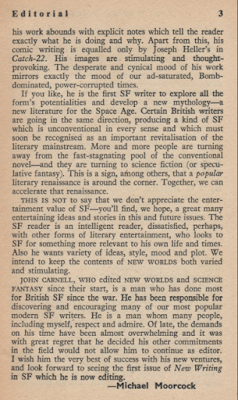
Saddened to hear that James Sallis is now sleeping The Big Sleep. I first discovered him as a crime writer in the 90s with a series of novels that broke the genre mold. At the time I was writing fiction, attempting novels that merged noir and sci-fi. I emailed a sample to Sallis and to my surprise he actually replied with some positive feedback. Despite his encouragement, I was unable to finish anything that I was really satisfied with. He worked on the new New Worlds magazine for a while in the late-60s and it was there that his first sci-fi short story was published. The editor, Michael Moorcock, introduced Sallis to the hardboiled crime classics which eventually lead him to writing novels that presumably made him money (Drive in particular) unlike the sci-fi. His sci-fi shorts are collected in Time's Hammers which has a fantastic introductory essay written by the man himself.
Yes, it's vey easy to get the wrong idea, which is different from having a wrong idea, isn't it? Or is it? You can have wrong ideas about what colour scheme to choose when the room needs a fresh paint job. You can have a wrong idea then of standing on an unstable object to reach the top of the wall with the paint brush, resulting in physical harm. DIY is a wrong idea full stop to me. As LJ often reminds me, left to my own devices, I would be inhabiting a place of peeling wallpaper, cracked paint and threadbare carpets.
Remaining silent on controversial subjects is, on the whole, a good idea, I think. That (un)said, if everyone did that we would never read an opinion. But perhaps that would be good. The internet being clogged up with chatter and megaphone declarations regarding politics, it's easy to find yourself swimming in a sewer of toxicity and, as you know with swimming, opening your gob at the wrong time can be most unpleasant.
In an age when activism is encouraged, I suggest inactivism as a beneficial alternative. That's right, sit down and shut up. Make yourself a hot drink, read a book. The world will continue to spin without you getting hot under the collar and spouting off. It will continue to be in flux, just as nature creates earthquakes, floods etc. Of course there are causes worth getting active about. Take cereal box packaging. have you experienced the weakening of the cardboard used? HAVE YOU?!!! Does it not infuriate you, first when you try to open the new box cleanly, only to find it tearing, then close it using the supposedly handy slit, only to find it impossible due to the flimsy cardboard? If that's not worth protesting about, I don't know what is.
Such flimsy products will not survive the apocalypse, but what will? Here's a 1962 film made for the BBC's Monitor series, directed by Ken Russell, script by archaeologist, Jacquetta Hawkes. An 'infection' seems to have killed off most of humanity, which reminds me that I saw two women wearing masks in a cafe yesterday, happily talking through them over their open laptops, as if mask-wearing was the most natural thing in the world. The fact that they were American may or may not be relevant. Perhaps, when not relaxing in a cafe, they were out on the street with other mask-wearers, being activists about something. Perhaps they had see The Lonely Shore and it panicked them into wearing masks...
The film raises the question: how are 'we', in the present tense of the commentator, living to be so dismissive of those 'first world' worshippers of indestructible goods? Post-catastrophe, are we devoid of materialism? Apparently people had 'too much ownership' and people now 'would not wish for such a burden'. Aside from the everyday objects, some vases on the shore are deemed so 'delightful in shape and colour' that they could not have been made by the British, but rather by 'invaders' or 'refugees'. Oh, a nice level of irony there. In fact, the whole film treads a thin line between condemnation of the modern world and celebration of it's oddities.
Considering that Hawkes was one of the co-founders of CND a few years earlier, it's likely that her fears of impending doom for the planet informed this post-apocalyptic vision. Her Left-leaning (?) politics may also have fed into the notion that material goods were somehow corrupting, rather than beneficial.
As if to steal from Pop Art and in particular Richard Hamilton, you'll note that it's an American car on the beach. Russell made the famous film, Pop Goes The Easel, also for Monitor, in the same year. I wondered that scene reminded me of and then remembered Hamilton's cover, created a year later for Living Arts magazine.
Well, here's the film, be it a critique of consumerism or just a good sci-fi short.