Showing posts with label Eduardo Paolozzi. Show all posts

Friday, 26 December 2025

Love & Napalm: Export U.S.A - JG Ballard / The Magic of Ju-Ju skull connection - Archie Shepp / Burroughs' cut-ups and concrete poetry


Continuing the JG Ballard theme (see last post), here's a Christmas present...from me to me - ha! Well, I swear it was comparatively cheap by at least £100, so I treated myself to this 1972 Grove Press first American edition. OK, it doesn't have the annotations by Ballard included in the Flamingo 2001 paperback but...look at that cover! Plus, it a hardback...it's a lovely size...it's so good-looking! You can over-indulgence in food at Christmas, but never books.


The painted skull by Alan Winston used for Love & Napalm: Export U.S.A. was also used five years earlier for Archie Shepp's album, The Magic Of Ju-Ju. Winston isn't credited in the book. I don't know about the album. I used to have it on vinyl but it went years ago, along with many others I've sold. Once upon a time I listened to a lot of Free Jazz and the title track of the album certainly is 'free'. But gradually I listened to it less until it then got to the stage where I joined the common listener in finding it bloody annoying! I'll dip in now and again, these days, but generally you could say my taste in Jazz has got more 'conservative'. 


When it comes to literature though, I suppose my taste is...'radical' (?), alongside genre fiction. Ballard's novel would certainly be considered radical amongst most people and The Atrocity Exhibition (it's UK title) his most adventurous work regarding structure. 

Ballard was a big fan of William Burroughs, as I'm sure you know. I see a connection between Burroughs' cut-up novels and concrete poetry when it comes to disrupting structures of 'normal' poetry and text generally to shape new images, new ideas and ways of looking at words and letters. A connection can also be made between Eduardo Paolozzi's 'sampled' texts and Burroughs, then to The Independent Group (of which Paolozzi was a member) and their influence on Ballard. That whole 'scene' inspires me greatly, from This Is Tomorrow to Abba Zaba, Moorcock's New Worlds magazine and British art in the 60s. 

Eduardo Paolozzi at New Worlds: Science Fiction and Art in the Sixties is highly recommended. The best place to buy it is here.


TTFN

Thursday, 18 September 2025

Metafisikal Translations - Eduardo Paolozzi / Paolozzi's artist's books (absence of)


I've been watching it for years. 

The price never dropped.

I couldn't afford this, the one artist's book by Paolozzi that I didn't have. 

Three weeks ago I got a tax rebate so I could afford it, in theory, but should I really spend that much on one book? A 48-page, screen printed book from 1962, signed by Paolozzi. Big deal!

'You don't need it.'
'Of course I don't need it. Who actually needs books? What do we 'need' apart from food, housing and enough money to pay the bills?'
'Then again, what's money? There are no pockets in a shroud, are there?'
'No, so you can't even take one book with you when you...go.'
'Don't remind me, please, of either my mortality or the fact that my book collection cannot go with me...and anyway, it'll be nothingness...forever...'
'So before you sleep The Big Sleep, buy what you want if you can afford it!'

Luckily, a London bookseller was offering Metafisikal Translations at the joint lowest price online so I emailed them and cheekily asked if they could drop the price at all. They agreed. It still took me a few days to finally decide to buy it.

Little seems to have been written about Paolozzi's artist's books. They're mentioned in some monographs, usually in passing. The best source has been Eduardo Paolozzi - Writings And Interviews, edited by Robin Spencer, a superb collection and essential for anyone wanting to dive more deeply into Paolozzi's work. That does include this book and The Metallization Of A Dream, but strangely, neither Kex nor Abba ZabaThe Metallization Of A Dream does get two pages to itself in the Whitechapel Gallery's monograph to accompany their major exhibition in 2017 and Judith Collins at least dedicates a page to Paolozzi's use of texts in her monograph, tying in his word collages with Gysin and Burroughs' cut-ups.

Obviously his major works according to most critics will be the sculptures, followed by his prints and collages but as someone who works with words and has had a few books made I naturally find Paolozzi's books fascinating. Anyway, here are a few pictures of my Metafisikal Translations. You can scroll through the whole book here on the Tate gallery page.


Thursday, 7 March 2024

Eduardo Paolozzi is 100 years old!


No, he's not actually 100 years old - he would be. So what better excuse for celebrating Britain's greatest artist...

Is he Britain's greatest artist?

No, he is the Greatest Artist of the 20th Century!

Is he?

Here's how I know: of all the monographs on artists I have, anything about or featuring Paolozzi has been pulled from the shelves more than any other books. What other evidence do you need?


Do you need a book on Paolozzi? Yes. But I can't recommend just one. The Judith Collins one, simply called Eduardo Paolozzi, is very good and full of colour images. The other essential one is Writings And Interviews, edited by Robin Spencer. The link takes you to one available on Amazon at the cheapest I've seen (£92). It seems to be ex-library but I'd snap it up all the same if I was you because it's packed with interviews and texts by Paolozzi unavailable elsewhere.


My most treasured Paolozzi books are those he produced (with help) in the 60s, the 'artist's books', Kex, Abba Zaba and The Metallization Of A Dream. Another, Metafisikal Translations has eluded me so far, being too expensive. You can see my post on Kex here. Abba Zaba is featured here. The Psychological Atlas is here. The brown book with the embossed cover is The Metallization Of A Dream...


Paolozzi was born in Leith, Scotland. To celebrate his 100 anniversary Leith Athletic F.C. have produced shirts and scarves inspired by The Man. Great idea, eh? I'd buy a scarf but they've currently sold out. Wearing it in London would certainly surprise any Scottish tourists.


I'll say no more because, as you'll see if you click on the Paolozzi tab on the side, I've said quite a bit about Him on this and my other blog. Suffice to say he has been and always will be a great inspiration to me through his writings and Art. So here are more pictures...


From Bash, an unpublished novel, late-60s


Monday, 20 March 2023

Book-Jumping - The Man-Metal Mechanoid World of Moderan by David R. Bunch / Paolozzi's Sculptures / Dutch Schultz, William Burroughs & Paul Sann / Collage: Tempted To Kill


I'm currently bouncing back and forth in time and place between a bunch of books (and one by Bunch), from Moderan to Kill The Dutchman! to Riddley Walker  - the first and last being contrasting visions of the future, one a plastic-wrapped planet populated by bio-mechanical 'humans', the other a primitive, ritualistic world after science. Both Bunch (Moderan) and Hoban (Riddley Walker) exploit the potential of language as a tool to describe imaginary worlds. 

As with Anthony Burgess' A Clockwork Orange and William Burroughs' cut-up 'novels', the brave new words and scrambled syntax used by Bunch and Hoban brilliantly break up common language to leave most formal sci-fi way behind. As you know, the most interesting futures in fiction were created by those who broke the genre barrier.

Whilst reading Moderan I was also revisiting one of my Eduardo Paolozzi books and his sculptures struck me as representations of Bunch's metal-machine men, despite being made decades earlier. OK, they're bronze, not metal, but despite making aluminium sculptures too (see last picture) it's the bronze mutations which seemed to be more Moderan-like since they too retain something human about them, albeit vague and suggestive.


Art and Fiction similarities aside, there's also a connection between Kill The Dutchman! and Burroughs, of course. The latter created The Last Words of Dutch Schultz as a screenplay to a film that was never made. Schultz's last words from a hospital bed were spoken whilst delirious from fever and fatally wounded (lead poisoning); being gibberish, they appealed to Burroughs, who used them as a springboard for his own interpretation. Paul Sann's telling of Shultz's life is so authentically Noo Yawk 30s reporter style you can small the cigar smoke and see the pages through his green visor as he hammers the typewriter keys. The tone is comic, hardboiled, and the book is highly recommended for a flavour of how gangster life and death was described at the time (although it was written circa 1970).

Here's a collage I made a few years ago using an image from the era described by Sann. I called it Tempted To Kill.


RTomens, 2019


Friday, 10 June 2022

Collage: WINK

RTomens, 2022

It's a homage, not a rip-off, Eduardo! 

Yes, I was looking at work by my Pop idol yesterday and decided to do something similar. To call Paolozzi 'Pop' doesn't do him justice, which is not to denigrate Pop Art, but to say that He worked far beyond the common boundaries and it's only a cheap label, eh?


Friday, 4 February 2022

My Favourite Artists (Top Three)

People frequently sometimes occasionally ask me who my favourite artists are and I'm sure the question has arisen in your noodle too, hasn't it? No? Oh well, I'll state them anyway, just for something to do...because, after all, this blog mainly exists as something for me to do that is not making art, washing up, working in the shop or watching the telly. Unlike, say, Top Ten Film lists, this one doesn't change, hasn't changed for a long time, which suggests that I've come to the end of the Discovering Favourite Artists road and that, in a way, is a bit sad. So in no particular order...

Rausch(enberg) Rumble


Robert Rauschenberg, I kneel at your feet. No I don't. Let me state early on, where such a statement must be made, that I idolise no artist, perhaps because I lived through the Punk era, during which we realised it was the twilight of all (old) idols (Elvis, the Beatles and The Rolling Stones), instead, replacing them with the likes of The Clash when, actually, we should have idolised no-one because that would have been more 'Punk', wouldn't it? Yet each generation needs it's 'Pop' idols, doesn't it?

When it comes to Artists, I made up my mind long ago that in order to Carry On Being Creative (have you seen that film? Hilarious turns by Kenneth Williams as a cruel critic and Sid James as an Abstract Expressionist who is permanently drunk and getting into fights) I could do without the 'burden of worship', which could see me permanently in awe rather than confidently continuing regardless.

Bob, though...I mean...the sculptures, collages, prints, performance art, paintings...he had it all, the swine! No-one made better screen prints. And no-one organised apparent chaos better on a canvas.

Roth (without the 'Ko')


Why not Rothko? He bores me. All that 'spiritual' guff. And rooms of his work where people can sit and contemplate the 'meaning' of...something - bah!

Dieter Roth was a dirty, rotten scoundrel, wasn't he? He liked a drink. He liked being naughty. His art was naughty, quite mad, potentially displaying real genius, but not actually doing so. The crazy drawings, absurd, amazing literary 'sausages', prints, writings, paintings and artist's books, especially the artist's books and his Little Tentative Recipe . His statement: 'If you don't want to give it up, go on until you can't stand it anymore' is both funny and as true as piece of advice as an artist in the mechanical age has given, emphasising as it does both the nature of being possessed by multiple production and how its relentless potential can drive one insane. Roth was a lord of misrule, breaker of taboos and head bouncer at the wildcard artist's bar, eager to kick all poseurs and pretenders up the arse.

Eduard(oh!) Paolozzi 


Oh yes! What can I say? Um. Have you noticed a theme emerging? Well done. Yes, all favourites so far have been eclectic in their media and styles. So, Eduardo Luigi Paolozzi; printmaker, collagist, sculptor and importantly (to me), co-creator of fantastic artist's books such as KEX. He was an early Pop star and contributor to Britain's sci-fi New Wave via New Worlds magazine. He was also a prose evolutionary (like Ballard) in his writings and text accompaniments to photos chosen specifically to suggest scientific, philosophical, artistic idea and an important contributor to the dawn of Tomorrow on the British art scene in the 50s. I've still no idea, though, what Wittgenstein was goin' on about!

That's all for now - the immediate Top Three but not all of those who've inspired me over the years, of course. There may be more to come, depending on how much making art, washing up, working in the shop or watching the telly I do in the forthcoming days and weeks.

Sunday, 16 January 2022

Eduardo Paolozzi 'Porn' Pictures Shock!


Naughty Eduardo! So I'm browsing the shelves of a Kentish Town charity shop last week when I spot the spines of a few Ambit magazines - bah! - not the earlier numbers I would have hoped for but worth a look, eh? To my delight, in no.189 (Summer 2007), there were these collage/drawings by Paolozzi. Absolute delight, I mean, because I'd not seen them before, nowhere, not in the books I have on Paolozzi. Perhaps, I thought, because they are naughty?

Crude, playful and, in a sense, typical of Paolozzi's rough-edged approach to many early collages they are, all the same, a surprise. I still wonder why they don't seem to be viewable online. I tried a search but found nothing (yes, I may not be using the right words). I'm not surprised that they didn't make the big Whitechapel Gallery retrospective in 2017. 

They may be 'BUNK!' in terms of his outstanding output, but they're still fun and show a different side to the man. 

The book you need on Paolozzi in Ambit is this one

TTFN


Tuesday, 18 June 2019

Eduardo Paolozzi's Psychological Atlas & the heady aroma of Dada and Surrealism


Travelling back through a double time tunnel, 40 years to it's publication and 30 to it's creation, here we look at Eduardo Paolozzi's Psychological Atlas. Handsome, isn't it? Yes? No? OK, it depends on your aesthetic preferences. But "Darling, shabby handmade chic is divine!"

It was put together in 1949 whilst Paolozzi was in Paris, no doubt intoxicated by the still-heady remaining aroma of Dada and Surrealism which lingered on, did it not, for another two decades at least?  So many artists of the 50s and even 60s would inhale both movements and breath their essence into sculptures, collage, painting and whatever else artists get up to - eh? 

Excuse me, I myself am slightly intoxicated by sniffing Paolozzi's Psychological Atlas, even though it does not smell of anything in particular, not old and musty but in surprisingly good condition therefore not in the least smelly.

The images are funky, though. Crude, comical, early collages in scrapbook form depicting fantastical scenarios featuring robots, machinery and cut-out characters, of course. If it's a psychological atlas it also acts as a series of road maps for future obsessions. There is always more going on with Paolozzi than meets the eye...philosophical and literary investigations, a fascination with juxtapositions, the meaning of which may only be clear to him or, not even clear, but subconscious, dream-like in the classic Surrealist manner. 

A fantastic little book.


Here's an old collage I made in 2013...it's equally crude...

Machine-Woman, RTomens, 2013


Thursday, 7 February 2019

Print: Red Ejection / Musings on my magpie mind


Red Ejection, RTomens, 2019

This piece is comprised of two images culled from the internet and another cut from a book. Various print techniques were then used to create the finished image.

Now...

I believe I have a 'magpie mind', although looking for precise definitions I could find none. So perhaps I'm on the wrong track. Those who can stay on one track for a long time, study something, made me envious, once upon a time. I wanted to be an expert in something, anything.  

It's not that my mind wanders or is continually lead from page-to-page on the internet, thank god, for what kind of hell must that be? I've seen tips for artists and writers on how to avoid that syndrome. Usually they involve simply turning the computer off or learning discipline etc.

No, I'm simply interested in a variety of things and have never chosen one to study. Since junior school I had trouble studying. I had trouble with school full-stop. Every teacher's efforts to impart knowledge fell on these deaf ears like so much snow on a wet road; dates, facts, historical figures, science etc all dissolving on contact. I was looking out the window, my mind 'miles away'.

Leaving secondary school qualified to do nothing much I spent subsequent decades doing just that with my brain. The longer that continued the more I began to envy those who had studied. Still, all knowledge is relative, isn't it? I wrote a book about Jazz. Compared to the average person in that, at least, I'm an 'expert'. Except that I'm not, which is why I wrote as myself rather than a conveyor of facts. That said, many a book on Jazz has revealed it's author's preferences through omissions, bias, etc.

I don't buy the 'jack of all trades, master of none' idea as a slight. Tell it to Picasso or Paolozzi. OK, they were exceptional. I mix and match styles, subjects and influences. My magpie mind collects things from film, literature, music and art to fill my creative 'nest. I'm not unique in that sense, I know. Still, I wonder, when seeing an artist work in one style repeatedly, whether they're as mono-minded about culture as they are creating images.

How our minds develop from the start is a mystery. Are we born with a type of mind? I really should study to find out, shouldn't I? Something in me set a course long ago that would never run straight regarding interests. Was I 'programmed' to be this way? Pulp fiction, philosophy, Jazz, Dub, Film Noir, Westerns, Concrete Poetry, Pop Art...I could go on...all in the mix. I can't help myself. It doesn't win me points when coming up against experts, but I thank them all the same for providing answers when I Google something. Thank god they studied. Meanwhile, finally, I'm content with how I am in this respect. It means I can name three Sartre novels and Kool And The Gang tracks. My life has not been wasted.


Saturday, 19 January 2019

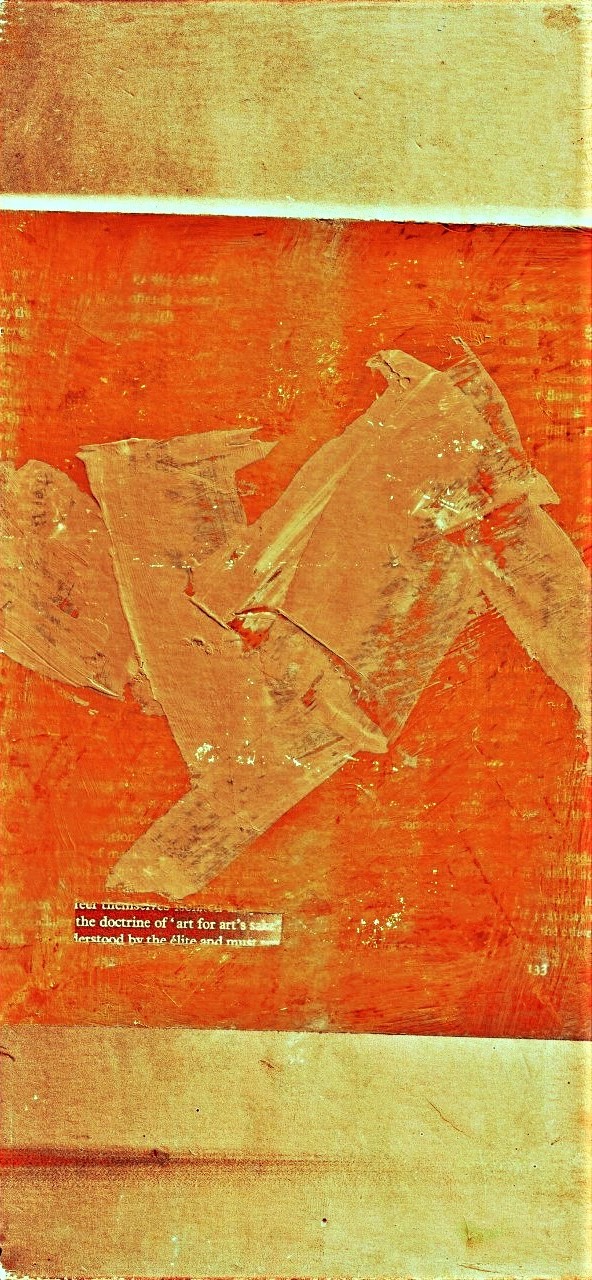
Art For Art's Sake, 5 Variation (print/acrylic) / Street Gallery vs The Internet


The internet as a projection screen....contemporary equivalent of Paolozzi showing slides of his 'Bunk' images at the ICA in 1952...

...compared to the SG (street gallery) - is one better than the other?


The supposed kudos of a SG show - based on the Fine Art tradition, which Internet Art supposedly challenges but can never overthrow because the old SG/FA deal is where the money is! Where the credibility stems from! Except that...unless you're already Known it's almost guaranteed to be no more than a lot of work (hanging), expenses (printing, paying the gallery) and no sales...but...you had a show! In a proper Gallery!


A succession of 'slides' then, on the internet, but not controlled by the projector; instead, the viewer chooses both their space (social platform) and the way they see the art, the speed at which they look...how does the swipe of a finger differ from the motion of legs in a SG? 

The SG experience is more tiring...here art is viewed in any position, at any time...lying down, standing at a bus stop, sitting comfortably, in the office (even!)...the SG offers art 'in the flesh', an incredible experience, yet how many people do you see actually examining a work of art? Really getting in close (don't cross the barrier and set off the alarm!)....to study a detail...very few.


Here art detail can be examined at the spread of two fingers...that is, should it first appear interesting. Theoretically, you paid your money for a SG show and should therefore spend more time with each piece, yet shows can be so big, so much work to see, so many rooms! So you walk, looking out for something that catches your eye...

Swiping through art presents a slightly different but related challenge. It's easy to swipe, too easy...a piece must really grab you to warrant the stillness of the finger....

And yet here, on the internet, we see democracy in action. We artists are confronted with exactly the same conundrum as those showing in SGs, namely how much should public reaction influence future works? Assuming the artist has not trapped themselves in one style already, do they create more of what proves popular? Or follow their creative whim? This issue is more relevant to the internet artist than the SG one, the latter only being able to gauge the popularity of a piece if it should sell, whilst the former can see how many 'likes' it gets.


Art on the internet is transient...as they used to say of news in print; it's wrapped in tomorrow's fish'n'chips, or in the case of art on a social platform, forgotten by tomorrow, usually. Perhaps a site like this is a stab at permanence. 

Thanks for calling in.